Legionella bacteria don’t appear from nowhere, they thrive under specific, well-understood conditions. Understanding what those conditions are is the difference between a risk assessment that’s a formality and one that actually protects your tenants. Here’s what we’re looking for on every visit, and why.
The legionella water temperature range that matters
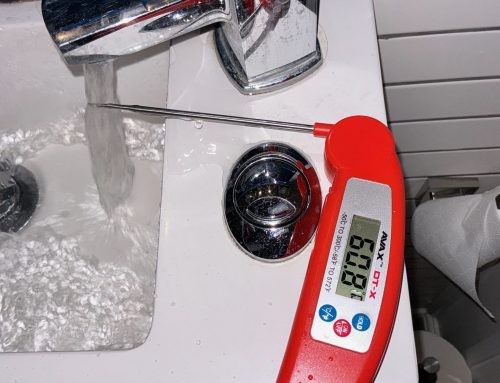
Legionella bacteria grow best in water between 20°C and 45°C. Below 20°C, growth is minimal; above 60°C, the bacteria are killed off within minutes. This is why every Legionella Risk Assessment centres on temperature checks:
- Cold water should stay below 20°C, even after running, to avoid warming into the growth range
- Hot water should reach at least 60°C at the cylinder or hot water source, and 50°C at the tap within one minute of running
A system sitting outside these legionella water temperature ranges, a cold water tank in a warm loft, a hot water cylinder set too low to save energy, is doing exactly what Legionella needs to establish itself, even if nothing looks visibly wrong.
What a “dead leg” actually is
A dead leg is a section of pipework that sees little or no water flow, a disconnected branch, a redundant pipe run from a previous renovation, or simply a tap or shower nobody uses regularly. Water sitting still in a dead leg warms towards room temperature and stays there, undisturbed, for as long as the outlet goes unused. It’s one of the most common findings in our assessments, and one of the easiest for a property owner to overlook, because the pipework itself is often hidden behind walls or under floors.
Infrequently used outlets: the everyday version of the same problem
You don’t need an actual dead leg to have a risk. Any outlet that isn’t used regularly, a guest bathroom, an outbuilding tap, a shower in a room a tenant doesn’t use, behaves the same way: water sits, warms, and stagnates. This is particularly relevant in rented HMOs and multi-let properties, where not every room or facility gets used every week.
Other conditions we check for
Beyond temperature and stagnation, a thorough assessment also looks at:
- Scale, sediment, and biofilm build-up in tanks, cylinders, and pipework, which can shield bacteria and provide a nutrient source
- The condition and accessibility of water storage tanks, including whether they’re properly covered and insulated
- Any recent changes to the system that could have introduced new risk, extensions, refurbishments, or added outlets
Why this level of detail matters
A surface-level check can miss all of the above, because none of it is necessarily visible without deliberately testing for it. That’s the real value a proper assessment adds: not just confirming the water system exists and looks fine, but actually testing the legionella water temperature and the specific conditions known to create risk, and documenting exactly what was found so you have a clear, evidenced basis for any action needed.
If you’d like to know what a full assessment for your property would involve, get in touch, or take a look at our sample report to see exactly what’s included.
What are the Benefits of using Bluewire Hub for your Legionella Risk Assessments?
Compliance with Regulations:
Our assessor holds the ABBE Level 2 Award in Legionella Awareness and carries out every assessment in line with the HSE Approved Code of Practice L8 (fourth edition).
Prompt and Reliable Service:
We pride ourselves on delivering efficient and reliable services. We’ll aim to schedule your assessment at a time convenient for you, and our turnaround time for providing Legionella Risk Assessments is quick and hassle-free. If you are looking for an urgent appointment we will always do our best to accommodate your request.
Expert Analysis:
Once the assessments are complete, we provide you with a detailed analysis of the findings, you can download an example report here. This helps you understand the potential risks and the necessary steps to eliminate them.
Clear Pricing:
We price by the number of taps in the property, so you pay for the size of the water system being assessed. Tell us your tap count on the form and we will send you an exact quote.