Will a gas boiler still get you EPC band C? Under the coming reforms, the answer looks like no
If you’re a landlord weighing up a heat pump against sticking with gas, here’s the headline: under the government’s proposed Home Energy Model, a gas boiler EPC band C rating will not be attainable on the new Heating System metric, no matter how efficient or new it is. That’s a genuine problem if your plan for meeting the 2030 minimum standard relies on your existing boiler doing the heavy lifting.
Right now, under RdSAP 10, a modern condensing gas boiler paired with decent insulation can comfortably deliver a band C EPC. Many landlords across Milton Keynes, Northampton and the wider area have taken exactly that route: fix the fabric, keep the gas boiler, get to C. Under the Home Energy Model, that route changes shape. This article sets out what’s actually confirmed, what’s still proposal stage, and what it means for anyone deciding whether to fit a heat pump now or wait.
I should be upfront: the Home Energy Model has not launched yet, and some of the detail below is still subject to the government’s formal response to consultation. I’ll flag where that’s the case.

What the Home Energy Model actually changes
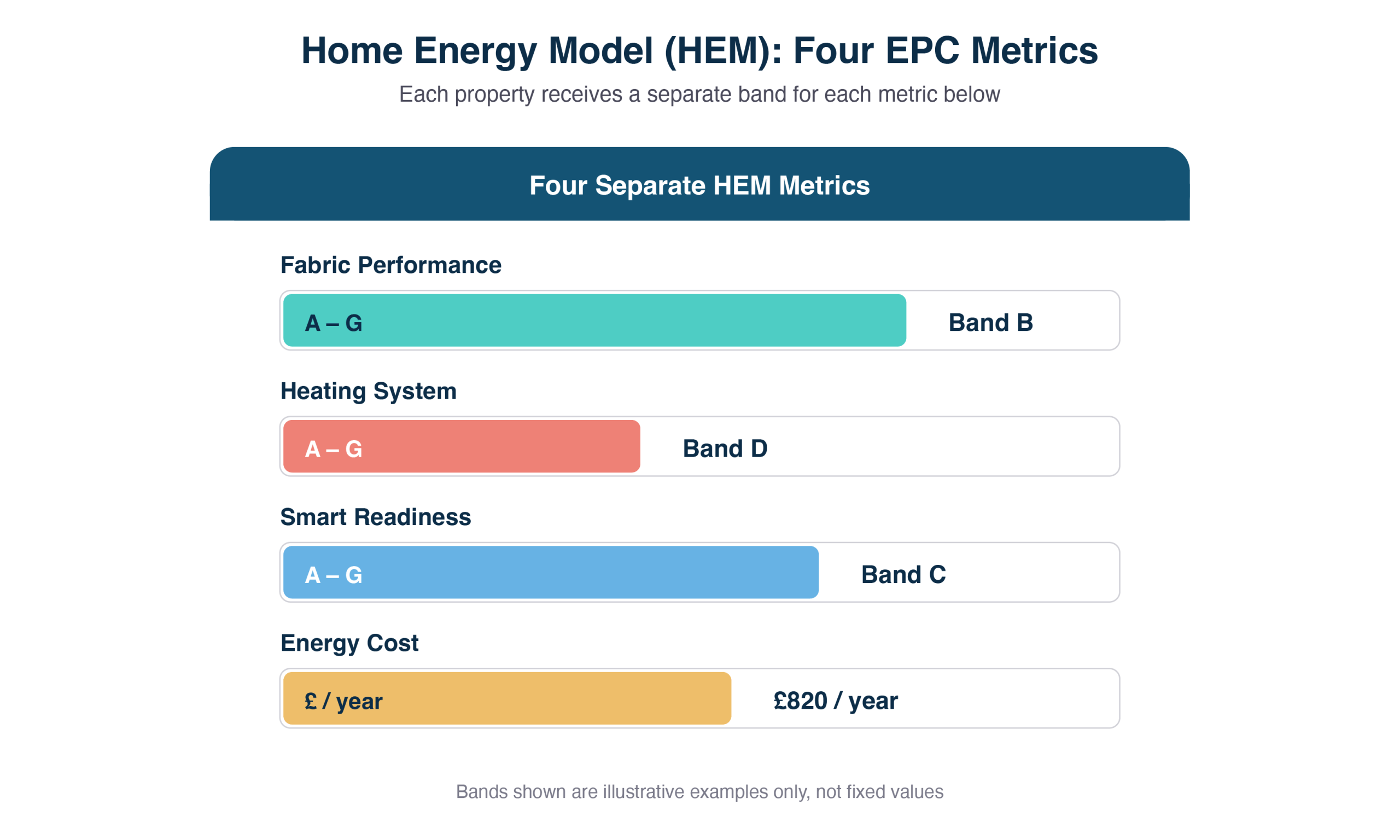
The Home Energy Model, HEM, is the calculation engine set to replace RdSAP for domestic EPCs in England and Wales. Rather than one A to G rating built from a single cost based calculation, HEM splits performance into separate metrics: Fabric Performance, Heating System, Smart Readiness and Energy Cost. Each carries its own band.
That matters because a property no longer gets to hide a weak heating system behind strong insulation, or vice versa. Under RdSAP, a good fabric and an efficient gas boiler can combine into a single, flattering overall score. Under HEM, the heating system is scored on its own terms.
Originally due in October 2026, the launch was pushed back to the second half of 2027, with the government confirming the delay in March 2026. The exact launch date is still to be published.
The heating system cap: what’s confirmed and what isn’t
This is the part worth sitting with. Under the Heating System metric as currently proposed, fossil fuel heating, gas, oil and LPG, including hybrid systems, is capped at band D. That cap applies regardless of the boiler’s age or efficiency rating: a brand new A rated condensing boiler scores the same D as one installed fifteen years ago.
I want to be clear about status here. This detail comes from the government’s HEM: EPC Assessment consultation, published January 2026 and closed in March 2026. A formal government response, including confirmed band boundaries, is expected later in 2026. So the direction of travel is well established, but the exact thresholds aren’t locked in yet. Treat this as highly likely, not yet finalised.
On a recent assessment in a well insulated 1990s detached house near Northampton, the fabric was genuinely excellent: good cavity fill, decent glazing, no obvious heat loss issues. Under RdSAP that property was a comfortable C. Under the proposed Heating System metric, its gas combi boiler alone would put a ceiling on that part of the score regardless of how good the rest of the house is. That’s the kind of gap landlords need to plan for now, not discover at renewal.
You don’t necessarily need to rip out the boiler
Here’s the part that gets missed in a lot of the coverage: the proposed 2030 minimum standard isn’t simply “hit C on everything.” As currently framed, a property would need to achieve band C on Fabric Performance, which is mandatory, plus band C on either the Heating System metric or the Smart Readiness metric, not both.
That gives gas heated properties a second route. If the Heating System metric is capped, and the gas boiler EPC band C rating isn’t achievable, a landlord could instead aim to hit C on Smart Readiness, potentially through solar PV and a smart meter, without replacing the heating system at all. Whether that’s cheaper than a heat pump depends heavily on the property: a solid wall terrace with poor fabric will likely need insulation work either way, while a well insulated house with good roof orientation for solar might find the Smart Readiness route genuinely more cost effective than a heat pump changeover.
This is exactly the sort of decision that benefits from a proper assessment rather than a guess, since the right answer depends on your specific property’s fabric, orientation and existing heating setup.
Should you fit a heat pump now, or wait?
There’s no single right answer, and I’d be wary of anyone who tells you otherwise. A few things are worth weighing:
The case for acting now: the Boiler Upgrade Scheme grant remains available, heat pump installer capacity is likely to tighten as the 2030 deadline approaches, and a heat pump satisfies the Heating System metric outright, removing the uncertainty around Smart Readiness thresholds that aren’t yet confirmed.
The case for waiting: band boundaries and the final MEES framework for HEM haven’t been confirmed, your existing EPC may still have several years of validity, and the Smart Readiness route may turn out to be the cheaper compliant path for your specific property once detail is published.
Either way, understanding your current fabric performance, not just your current overall band, is the sensible starting point. That’s the one thing that stays valuable under both RdSAP and HEM.
Get in touch
If you’re a landlord trying to work out whether your property’s current fabric and heating setup gives you a realistic path to the 2030 standard, or whether a heat pump makes sense for your specific house, an up to date assessment against RdSAP 10 is the right place to start. Get in touch and we can talk through what your property’s numbers actually look like.